You are here: Material Science/Chapter 1/Fatigue
Introduction
Fatigue is one of those concepts that is very easy to understand, but quite difficult to analyze. Imagine taking a paperclip and bending it back and forth repeatedly. You can imagine that at some point, the paper clip will crack, and shortly following that, will break into two pieces. If someone handed you a paper clip and asked you to break it in two using only your hands, I imagine this is exactly the process you’d use to break it. It’s a little bit too strong to break with your hands in one movement.
Fatigue, out of the engineering context, really means tired. I like to think of it as the material, after a lifetime of stresses, grows old and finally breaks. Another commonly used word in the place of fatigue is durability. How durable is the material? How long will it last?
What causes fatigue?
Fatigue is a phenomenon that results due to the material seeing changes in stress. It is the cycling of stresses between different values that ultimately causes failure. Which is really interesting – think of this case: you could pull a piece of steel in tension with some force and it would never break. But if you pull that piece of steel with the same force, and then a second later unload it completely, then a second after that loaded it again back to the same force – if you did this over and over again, for a long time, then there’s a good chance that eventually it would rip apart. Even though the static (not changing) stress wasn’t high enough to damage the material in any way. This mode of failure is a real headache for engineers: the part can fail at a lower stress in fatigue than it would otherwise. Now we have to design for that too.

A very short history of fatigue
The legend goes that the concept of fatigue was discovered due to train accidents. Long ago, during the industrial revolution, train axles were breaking, causing train accidents and general chaos. The engineers were flummoxed. They felt that the axle was strong enough – the train clearly worked for a while – so why the sudden failures after a long period of time? The stresses were well below what should cause yielding of the axle, so they were left scratching their heads for some time. Until the concept of fatigue arose.

How common is fatigue?
Very common. It doesn’t take long to imagine how many components in real life service will see fluctuating stresses. The train axle, clearly. Many, many components in a car. Think about it: over the lifetime of a car, it will drive over many potholes, drive over bumpy roads, hit curbs, accelerate, brake, corner. All of these cause varying levels and types of stress in the suspension, the chassis, the wheels, and pretty much everywhere in the car. None of these things are enough to cause yielding or fracture on their own – but add them up over many many thousands of miles and fatigue is almost inevitable. You can find examples of potentially damaging fluctuating stresses nearly everywhere. A laptop screen opening and closing. An airplane pressurizing and depressurizing. An airplane in turbulence, or landing and taking off. Really, so much fatigue everywhere, and it’s a damn shame, because fatigue cause the vast majority of failures.
Fatigue is an extremely common failure mode.
Fatigue should really be considered in designing any part that will see fluctuating stress, but only when it makes sense to do so. A car or airplane? Fatigue definitely needs to be considered. Designing a chair? Probably not necessary to perform complex fatigue calculations. Probably.

Fatigue is the most common failure mode
By some estimates, fatigue is responsible for 90% of all real life failures of metals, which is a staggering number. I don’t know how accurate the number is, but I’m sure studies have been done by some engineering group. I can tell you from my own experiencing analyzing suspension components, the designs are usually fatigue limited (literally, limited by fatigue). That means that we could make the parts lighter because they are more than strong enough to survive large one-time loads such as hitting a pothole, but if we remove any material from them (make them lighter) then they will won’t be expected to survive fatigue loading. In other words, they are overbuilt in terms of strength, but the threat of fatigue failure means we need to make them even stronger.
Designs are often fatigue limited.
Fatigue is difficult to estimate
Engineers are generally good at estimating how strong a component needs to be to survive individual loads, but determining whether the component will fail due to fatigue can be extremely difficult even with advanced computer software. Part of the issue with this is the probabilistic nature of fatigue loading. If you took several specimens of exactly the same material and loaded them exactly the same way, you’d end up with a spread of results. Maybe some test specimens would have failed at 10,000, maybe one at 12,368, maybe one at 9,200. This makes estimating fatigue so difficult. Even with a carefully controlled lab setting, we still can’t pinpoint exactly when fatigue will occur. Sometimes, it’s considered a good estimation even if you’re 2 or 3 times off (e.g. you estimated that the part will survive to 30,000 cycles, but it fails at 60,000 cycles). And as a result components are usually made with conservative assumptions made – to err on the side of caution. The fatigue models are often put together with conservative data. One such example is that we assume the material is much weaker than it will likely turn out to be.
These conservative analyses often result in many components being overbuilt – designs are often heavier than they likely need to be – but that is the current reality of the fatigue beast. Fatigue, to make matters worse, is like a brittle fracture. There’s really no plastic deformation before failure, so there really isn’t much warning provided before failure occurs. Sometimes cracks can be seen before failure occurs, but small cracks are not as obvious as plastic deformation.
Fatigue is difficult to predict, even with advanced software.
How does fatigue happen? What do we consider as a failure?
It occurs in two main stages: first, after much loading, a crack will begin to form at the surface. This is called crack initiation. Now that the crack has formed, it will begin to grow if the component is continually loaded. This is called crack propagation.
There is some discretion here for what is considered a failure. Often it is up to the engineer, based on the design and circumstances. Some engineers say that as soon as crack appears, it is considered a failure – the part is now broken. Obviously this is a conservative approach. It is likely that the component would remain structurally sound enough (i.e not break into two pieces) for some amount of time even with the presence of a small crack. But this approach is obviously a bit more optimistic. The presence of a crack means that the component is weaker, and that crack could be large enough to form a stress concentration. The part has been compromised, and so it is considered a failure.
In reality, many components are left in service with small cracks – as long as they haven’t reached some critical length determined by engineers. For example, engineers may do a visual inspection of a component and find a crack that is 0.1 mm – and maybe they won’t take the component out of service and replace it until it reaches 1.0 mm. It really depends on the situation, the material, what is at risk, and many other factors. If nothing bad happens when a part fails, then engineers may choose to squeeze every last bit of use out of the material, and only replace it when there is a catastrophic failure – i.e, the part breaks into two. At the end of the day, these companies are all trying to make money, and so using a material until the end of it’s life, and therefore avoiding buying as many new parts, is advantageous in terms of cost. But they must also weigh this against the cost of failure, which may not be able to be quantifiable (loss of life, damage of a companies reputation). It is always a balance which requires engineering judgement.
Fatigue failure can be defined in different ways.

Crack Formation
Recall that dislocations move when the resolved shear stress is high enough. In the case of a simple edge dislocation, this causes that extra plane of atoms to move along within the material. When the extra plane comes to the surface of the material, it will jut out. So now we’re left with a surface that is a little bit jagged. If this mechanism continues, and more dislocations arrive at the surface, then eventually what appears to be a crack begins to form. And crack initiation is the first step in fatigue.

How does fatigue occur at stresses below yield?
What’s important to understand about this process is that it can take place at a stress that is below the yield stress of the material. A formal definition of yield is the stress at which dislocations begin to move within the material. Well, that is true. But the actual yield point is a bit of a mystery. Usually, yield means that there are enough dislocations moving that it causes the part to change shape – i.e. plastic deformation. We can use the 2% offset method to estimate the yield strength. They key part is that yield requires bulk dislocation movement. But at stresses below the yield stress, the critical resolved shear stress is high enough to cause some dislocation to move – the low hanging fruit. We know that dislocations, both screw and edge, or some type of mixed, are essentially an extra half plane of atoms. It is this plane of atoms – the dislocations – that move through the rest of the crystal structure when the applied stress is high enough. When stresses are cycled, these extra half planes of atoms will move a small distance with each cycle and can eventually find their way to the surface of the material. Two things can happen at the surface: either the extra plane of atoms emerges (extrusions), or it goes the opposite direction and leaves a notch at the surface (intrusions). These are called persistent slip bands. These, in turn, act like stress raisers at the surface, and eventually a crack will form. Initially, the crack will grow along the shear stress direction – 45 degrees into the material, also known as the slip plane. At a certain point, it will shift direction slightly and grow perpendicular to the applied stress.
Dislocations can occur at stresses below the yield stress of the material.

Tensile forces drive crack propagation
Here’s another key lesson about fatigue: for that crack to grow, there needs to be a force that tends to open it up. In other words, there must be a tensile load that tends to pull the crack apart. Think of a piece of paper with a tear in the side of it. You aren’t going to have much luck getting that tear to continue tearing if you try to compress the crack. That just serves to close the crack up. You need to apply a tensile load (in most cases). Unfortunately, there usually is a tensile part of the load that a component sees. While there are parts out there in the world, working everyday, that see only compression, they are certainly more rare.

To make things more difficult, this is only a rule of thumb – fatigue can still occur with purely compressive loads, but overall compressive forces have nowhere near the effect of tensile forces.
Fatigue failure will almost always be a result of tensile stresses.
Damage
You may think that giving the material some ‘rest period’ will allow it to recover. For example, not flying an airplane for a certain amount of time and hoping that cracks in the fuselage will heal. Unfortunately, fatigue is non-recoverable. In other words, the damage is cumulative – any loading causing fatigue damage to the part will add up over time – no matter any gaps in the loading. Damage is a term that is used extensively in fatigue. Basically, it means exactly that – when a part is loaded cyclically with varying loads for a long enough time or at a high enough stress, it will experience damage until it breaks. This is known as Miner’s rule, something that will be discussed in another chapter.
Fatigue damage is cumulative and permanent.
The basic factors affecting fatigue
What conditions are necessary to cause fatigue failure? It can be very complicated to determine, and depends on numerous factors – which we’ll get to. However, there are basically three essential factors. Number one: there must be some variation in stress. Constant loading will not cause fatigue failure. Two: the peak stresses (i.e. the maximum stress that the material sees) must be high enough. If the stress is really tiny, then fatigue failure might never occur. Third: there must be enough cycles to cause failure. A failure due to large stress but zero cycles is not a fatigue failure, it is a static failure.
Fatigue is usually grouped into one of two categories: high cycle fatigue, and low cycle fatigue. Low cycle fatigue is considered to be any case in which the design fails at under 10,000 cycles. Usually, each cycle causes plastic strain. Alternatively, high cycle fatigue is above 10,000 cycles, and each cycle usually does not cause plastic strain. As we’ll see in the next chapter about fatigue (to be posted), this distinction is important and plays a major role in predicting fatigue. For now, we’ll limit our discussion to high cycle fatigue, and assume that there is no plastic deformation involved.
Fatigue is classified as either high cycle or low cycle.

Predicting fatigue failure and the S-N curve
The three factors above – stress variation, amplitude, and number of cycles – are interrelated. We need to know about each of these in order to predict and understand fatigue. For example, the stresses might be relatively low but the component might see a billion cycles. Or the component might see really high stresses, but cycles are low. Or the component may see a large variation in low stresses. So how do know what combination of cycles and load will cause failure? In short, using experimental data: the S-N curve is how we know. In reality, it is a little more complicated than (particularly with low cycle fatigue) that but we’ll approach it one concept at a time.
The S-N curve stands for stress-cycle curve, where S = stress and n = number of cycles. It is simply a graph, with stress on the y axis and number of cycles on the x-axis. The curve is useful, because it shows how many cycles the material is expected to survive at a given stress. An example of a curve is below (for illustration only). Let’s say you are designing a bike frame and you expect stresses cycling between +100 MPa and -100 MPa. You can look at the graph and find the stress on the Y-axis, which is 100 MPa, and trace your finger across horizontally until it intersects with the data for the particular material you are using – say the green line, for steel. Then trace downwards to the x-axis, which will show you how many cycles it will last for at that particular stress – in this example lets say 200,000. Maybe 200,000 is too low, so you know that you need to reduce the stress on the component. If you know the number of cycles that the component must withstand, then you can find the maximum allowable stress for the component for that number of cycles.
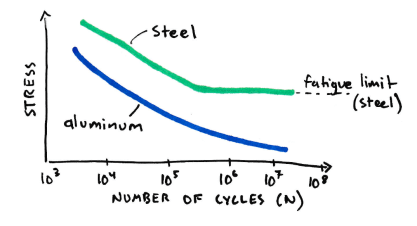
With some materials, there is what is known as a endurance limit, or alternatively, a fatigue limit. Essentially, this is just a stress on the S-N curve. If the stress is below this level, then the component will never fail – it will last an infinite number of cycles. If the stress is above this number, then the lives will be finite. It will fail at some point. Obviously, as you increase the stress, the number of cycles that the component can last will become lower and lower. The endurance limit (or fatigue limit) exists for many steels, and is usually somewhere between 30% to 60% of the yield strength. For example, with a steel that has a yield strength of 700 MPa, the endurance limit might be 300 MPa – which means that you could cycle back and forth between +300 MPa to -300 MPa and never have fatigue failure. The component would work forever! Not all materials experience this endurance limit – for example, aluminum, copper and magnesium. These materials will always fail, even at very low stresses, if they are cycled enough. Sometimes as a useful measure, a number called the fatigue strength is specified – which is essentially the stress at which the material will fail at some number of cycles.
Some materials have a endurance limit.
Where do these magical S-N curves come from? As with everything else we know about a material (such as yield strength, ultimate strength, ductility, etc) it must be tested in a laboratory. Basically, specimens of certain metals are loaded at different stresses until they fail. They run this test at a number of different stress levels, and from this data they can connect the dots and create the curve. Usually, the test begins at a stress that is quite high – probably around 75% of the yield strength. This will give a small number of cycles until failure. The stress is backed off until an endurance limit is found, if there is one.
There is significant variability in fatigue results. Even with carefully controlled loading in a laboratory, and specimens that are virtually identical using the same material, there will be a spread of data. One sample might live to 11,000 cycles at 100 MPa, and the next might surface to 14,560 with the exact same stress. Often the average, or median, fatigue life is defined. For example: at 100 MPa, half of my samples might fail below 12,000 cycles. If I needed the component to survive to at least 12,000 cycles in its real life application, then I would only have about a 50% chance of the component actually surviving to that number of cycles. Which aren’t very good odds, although maybe its good enough – the cost of failure must be considered. On the other hand, if we needed the component to survive 9,000 cycles and only 1% of the test specimens failed below 9,000 cycles, then we’d be 99% confident that our component would survive in its real life application. Just keep this in mind, especially since a lot of fatigue curves out there show the average values. Unknowingly basing important calculations on average fatigue values could result in an unexpected failure.
Fatigue data is often the average value of many tests.

Loading variation
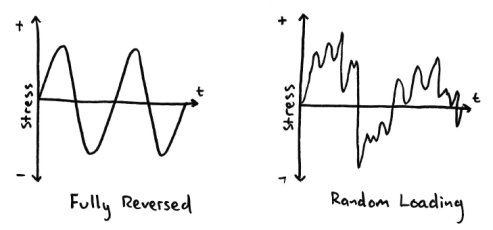
Fatigue loading can be quite varied. One of the most basic loading types is fully reversed. In this scenario, the minimum and maximum stresses are equal but opposite. For instance, something being bent back and forth with the same force will experience equal tension and compression. The figure below shows an example setup, used to generate S-N curves, in which a specimen experiences fully reversed loading. The specimen is rotated while a mass is hung from the centre. This puts the bottom of the sample in tension, and the top in compression. The sample rotates at high speed, create cycles of compression and tension in the sample – as seen by the two cross-sections on the right side, where red indicates tension and blue indicates compression. The black indicator notch shows that all areas of the sample are put into equal amounts of tension and compression. This is fully reversed loading. This is how most fatigue tests are done, and where the S-N curve comes from.

Can you see the issue with the S-N curve? The data is often generated using a fully reversed loading setup. This is because the test is easy to perform, and results in standardized data. But in reality, loading can be quite complex and jump around all over the place. Think of a car suspension. The loads will be jumping around as the car or bike hits bumps in the roads and accelerates and brakes. If we’re to accurately predict fatigue, we’ll need to make corrections to the S-N curve to account for our specific loading cycle – something we’ll also discuss in greater detail in later chapters.
Additional factors affecting fatigue
We mentioned what we need for fatigue failure to occur: variations in stress, high enough peak stresses to cause some damage, and enough cycles to cause failure. But there are many more factors that affect fatigue.
Mean stress is one such factor. With fully reversed loading, the mean stress is zero in this case. Zero because taking the average of the peak stresses will obviously give you zero. However, we know that this scenario is unlikely in real life conditions. Can you think of any cases where a component experiences fully reversed loading? Components typically see variations in stresses, which means the mean stress will rarely be zero.
A non-zero mean stress complicates things slightly, because S-N curves are usually generated using fully reversed loading – like . So when using software to analyze complex loading, we’ll need to ‘correct’ this – since our material data is zero mean stress and our loading likely does not. But first: the effects of mean stress. Simply put, increasing the mean stress will lower the fatigue life. So with our bike frame example, we’d expect the life of a frame with stress ranging from -100 MPa to +100 MPa to be higher than the same frame experiencing stress from -50 MPa to +100 MPa. Which seems a little counter-intuitive at first, because -50 MPa is ‘less stress’ than -100 MPa in terms of amplitude. But remember that the negative sign represents compression, and compressive loading generally does not lead to fatigue failure – because you’re squeezing the crack together, not opening it. So if the range is -50 MPa to 100 MPa, the mean will be +25 MPa, meaning that the component is spending more time in tension than the fully reversed example.
Mean stress should be minimized if possible.

Geometry effects. A very important tip for your design: the shape (geometry) of the part has a massive effect on fatigue life. Any abrupt change in shape where stresses tend to ‘pile up’ (i.e a stress concentration) will be a likely candidate for where a crack initiates. A classic engineering example: square windows on the comet jetliner in the 1950s. Who would have though the shape of the windows would be of structural concern? The engineers at the time certainly didn’t. But the varying loading that fuselage saw while in service resulted in stress concentrations at these window edges – because they were abrupt and square and the stresses has no choice but to bunch up around the window – and it was at these edges that cracks initiates. Eventually these cracks grew some critical length and the crack propagated suddenly: catastrophically: three of these planes broke apart in mid-air. The lesson here: avoid abrupt changes in design shape whenever possible. All corners should have a smooth, rounded transition. Holes in the part should be round whenever possible – not square – not triangle.
Stress concentrations should be avoided to maximize fatigue life.


Surface effects are a large factor. This is because the crack tends to begin forming at the surface of the component, where the highest stresses are always located. We know that any sharp geometry change leads to higher stresses (a stress concentration). Well, this same effect plays out on an extremely small scale too. If the part has a really rough surface, under a microscope it looks like a bunch of jagged edges – all stress concentrations. Stresses will be higher on a rougher surface, and the part will fail sooner. A component that is cast – say, with a sand mold – will have quite a rough surface, visible to the naked eye. A component that is machined will be very smooth. As a result, the machined component will last much longer. However, machining is not practical in many situations due to cost (see the manufacturing section for more detail). And since the casting will have a really rough surface compared to the machined part, you’ll need to add material, or use stronger material, to achieve the same fatigue life with the cast component. A bigger, stronger part means more material, and also results in higher cost.

However, there are ways to improve surface finish. One concept is to introduce residual compressive stresses on the surface. Residual, meaning that there has been some plastic deformation and a stress remains even when the part is not loaded. One way to do this is called shot peening. Basically, it involves taking the component and shooting tiny steel balls so that the ball makes a small imprint on the surface. This leaves compressive stress on the surface. Do this everywhere on the part, and you’ll have surface that is in compression. Which is great news, because the compression counteracts any tension that the part will see (to an extent), and we know that tension wants pull cracks apart. The shot (steel balls) will leave a compressive stress into the surface roughly 1/4 to 1/2 the diameter of the shot. Shot Peening can drastically improve the fatigue life of a component and should be considered when feasible and if necessary. Another way to improve the surface finish is to case harden the component. Basically, this invoices exposing the component to an atmosphere rich is carbon or nitrogen. The carbon or nitrogen will diffuse into the surface of the component and live in interstitial sites, making it stronger. This takes place at an elevated temperature, as diffusion is more effective when the atoms can move around more easily. Usually, this is about 1mm into the depth of the component. Which may not sound like a lot, but it’s pretty effective because the cracks will initiate at the surface, so it doesn’t need to go down that deep. A somewhat classic example of when case hardening is used is for a gear, such as a gear that you would find in an automotive transmission. The gear experiences relatively high stresses, especially high contact stresses, and is cyclically loaded as the gear teeth engage, disengage, and engage, over and over again. However, it is easier to manufacture the gear (which would typically be machined) if the material is softer – it is easier to work with. A more ductile material in the core is also preferable, so that brittle failure is avoided. And so the outside of the gear is case hardened.
What about the effects of the conditions in which the component operates? A component that sees a wild variation in temperature and also corrosive conditions (such as near an ocean, where there is abundant salt in the air) will fail earlier. Variation in temperature is known as thermal fatigue, and it occurs because as a material is heated, it will want to expand. If anything is restricting this expansion, it will introduce stresses on the component: it will want to grow larger but is unable to. It may then cool, and repeat the cycle. Failure can occur with these conditions even if there is no other external forces applied. An obvious answer for eliminating any potential for fatigue failure due to temperature changes: give the material room so that it can expand and contract without restriction. If a material is simultaneously experiencing a cyclic stress and a corrosive chemical environment, then the fatigue is accelerated – quite bad for the material. An example might be a component of a car that experiences fluctuating stresses and the driver happens to live close to the ocean. The air close to the ocean contains salt which is an accelerant in corrosion. The pits caused by corrosive action become stress concentrations, and cracks are likely to initiate at these sites, just like cracks are likely to initiate on sharp edges or corners of a design. Not only crack initiation is affect – the corrosive action will cause the crack to grow faster as well. An easy way to extend the life in this type of environment is to lower the stresses that the component sees by either changing the loading (not always possible) or by adding more material, so that the force is spread out over more atomic bonds. Of course, there are actions that the engineer can take to directly reduce the effect of the corrosive environment, such as protecting the component in some way (such as protective coatings), using a different material that is less likely to corrode, or to somehow eliminate or reduce the corrosiveness of the environment (which in most cases, I’d guess this would be difficult to do).
Now that you know some of the basics of fatigue, let’s explore fatigue in more detail. I also want to cover the use of software and some of the basics of using the software and what it does. In university, you probably won’t learn to use fatigue software at all. Instead, the professor will opt to teach you about calculating fatigue by hand. Which may be a good starting point, but this is rarely done in industry, I’ve never seen it in the automotive industry. The parts are too complex, the loading is too complex, and the calculations by hand become nearly impossible for anything except the most basic of cases. This means that you’ll use software in the “real world”, and software approaches fatigue a bit differently, so learning some basics here will hopefully help you, should you ever come across it in your professional career.
A side note here: fatigue has almost become more of an issue recently. For example, let’s think about cars for a second. Many cars have been on the roads for decades, and you rarely hear about fatigue failure, of, say, a suspension component. Even with hundreds of thousands of miles. But, when these cars were built, engineers did not have access to the type of fatigue software that is used today. So how did these parts survive? Engineers were quite aware of the fatigue issue, but they didn’t have the means to properly analyze and optimize the parts that they were making. Extensive real life testing was performed to ensure that the parts would survive and not fail early in fatigue. Additionally, engineers built components larger and stronger to avoid fatigue failure. Now we have software that can tell us where fatigue is likely to occur and when it is likely to occur. This allows for quick refinement of a component, and also allows for engineers to reduce the mass of the components while still ensuring that the components will survive. But this also means more reliance on the software.
You are here: Material Science/Chapter 1/Fatigue
Failure/Chapter 2 —>
 the first year engineer