You are here: Material Science/Chapter 1/Stress, Strain & Elasticity
Introduction
This next section is really the fundamentals of material science, at least from a practicing engineer’s perspective. Here we talk about material properties; specifically, mechanical properties. Because materials can have other properties than just mechanical ones; for instance, they can have electrical properties – how well they conduct electricity, for example. Mechanical properties deal with concepts such as: how strong is the component? When will it break? Will the glass on my phone shatter if I drop it? Will my car rim dent if I hit a curb going 30 km/h? Will my suspension catastrophically fail after hitting a pothole for the 10,000th time? Why is it a bad idea to have square windows on an airplane? The designers of the passenger jet back in the 50s certainly thought it was a fine idea, until the plane broke apart in flight due to the shape of the windows.
To talk about properties such as strength, we need to know why it matters. Almost everything that is engineered is made of one or more materials. Car components, coffee machines, components in a laptop, houses, bridges, the list is endless. Admittedly, for some of these items, the mechanical material properties aren’t of too much concern. In that case, the company will usually pick whatever material will perform adequately and is the cheapest, like plastic for a coffee machine (you’ll probably come across some variation of the saying ‘engineering is adequate performance for the lowest possible cost’ or ‘anyone can build a bridge for a dollar; an engineer can do it for 5 cents’ or the slightly more cynical/humorous version ‘anyone can build a bridge, but it takes an engineer to just barely build a bridge’). If the part is subjected to forces, in other words, if it is a structural component, then it begins to matter not just from a cost perspective. It matters from the will the part break perspective. No suspension arms will be made of plastic anytime soon (unless great advancements in plastic are made) since it is highly unlikely that a plastic part would be able to survive forces that a suspension is subjected to. This is why this section is so important. We’ll talk about material properties as they relate to the forces or loads on a part.
Force and Stress
Before talking more about material science, we need to introduce some mechanics concepts (very briefly).
First, a discussion regarding forces. Force is equal to mass times acceleration. If you have some object at rest (not moving), and it has some mass, then a force will be required to begin accelerating (moving) that object. When that something resists the force because it is locked into place somehow and unable to move, the object will instead will carry that force. A simple example would be applying a force to a wooden board. If the board is unattached to anything, just sitting there, then you will be able to move it, provided it is not too heavy. However, if the board is nailed down, it will not move; instead, the board will carry that same force. You are trying to move it with a force, but the board is fix, and so the force is transmitted to the board.
Knowing the force on a part is only the first part of the equation. What we really need to know is the stress, which is calculated from both the force and the geometry of the part to which the force is applied. An example: you apply a force of 100 N (roughly 22 lbs) to a steel rod that is a 1 foot in diameter. Is it going to break? Of course not. Now imagine the same force but the diameter of the steel rod is the width of a hair. Same material; same force. Will the thread of steel break? You’d probably be inclined to say yes, because it is a large force for such a tiny piece of steel. The stress in the material changed. With the giant one foot diameter rod, the force was spread out over a large area, so overall the stress in the material was low – the load is shared between many atomic bonds in the material. With the tiny rod, there is barely any area for the force to be spread over and just a few atomic bonds have to bear the brunt of the load. As a result, the stress is much higher, and the tiny rod breaks. So engineers are mostly interested in the stress on a component, because the force does not tell the whole story. But to know the stress, you must first know the force.
Stress is force divided by the area: Stress = F/A. If the area is larger, the stress will decrease for the same force. This makes sense intuitively, but you may have never seen the actual equation behind it. The area we’re talking about here is the cross section of the component, perpendicular to the force being applied. In the steel rod example, the force is applied along the rod (longitudinally) because you’re pulling on one end. If you cut the rod in half and look at the newly exposed surface, that is the cross sectional area. Decrease the diameter of the rod, and therefore the area, and the stress goes up. The length of the rod does not matter. (Actually that’s not entirely true – it does matter in some cases, but for a different reason that we can talk about later. It’s not currently important).
So we have a sense of force and area and stress and how they relate. You need to know the force and the cross sectional area of the part (based on the direction the force is applied) in order to find out the stress. Once you know the stress, you can begin to determine which material is appropriate.
Tension, Compression and Shear
Now keep in mind that there is more than one way to apply a force to that steel rod, and it matters how we do it. If we pull on it from both ends, we’re trying to stretch it out, to make it longer. This is know as a tensile load – the rod is in a state of tension. The rod is in a state of tension. If we try to push on the rod from both ends, we’re trying to make it shorter. We’re trying to compress it. This is know was a compressive load – the component is in a state of compression. If we try to twist the bar by turning it at each end in opposite directions, then we twisting it – this is known as a torsional load, or a shear load. We are trying to shear the rod apart. Those are the three principle ways of applying a load. Tension is pretty simple to understand. Often the loading is some combination of the three. Shear is typically the most difficult of the three to understand. Check out the drawings below for an example. A pool noodle is perfect for illustrating, if you have one lying around. A roll of paper towels will also do the trick.
Strain
Related to stress is the concept of strain. Strain is something you’ve probably understand intuitively. Strain is the elongation (stretching) of the component. If you take an eraser and pull from either sides, thus loading it in tension, what do you expect to happen? The eraser will stretch a little bit right? And the technical term for this ‘stretch’ is strain. Strain can be calculated as the change in length over the original length. There are no units; if you like you can multiply by 100 to turn the strain number into a percentage of the original length that it has changed. Example: if the original length of the eraser is 50mm, and you stretch it 1mm, then the strain is (1)/(50) = 0.02, or 2% change in length. If you compressed the eraser, you’d end up with negative strain.
Young’s Modulus (Or Modulus of Elasticity)
Or, a measure of material stiffness
Tying together the previous concepts, we can relate stress and strain for a given material. If we know the stress then we can calculate the strain, or vice versa. In order to do so we need a material property called the modulus of elasticity, also known as Young’s modulus. The symbol for this is E. This material property tells us the stiffness of the material. It relates stress and strain in one equation. Assuming that we know what material we are using, we can take strain and multiply it by the modulus of elasticity to calculate stress. Conversely, if we know the stress in a material, then we can calculate strain by dividing the stress by modulus of elasticity. So if you know either the stress or the strain, you can calculate the other. Young’s modulus (used interchangeably with modulus of elasticity, or sometimes just modulus) is the ratio of the stress to the strain.
There’s another way we can look at it. Remember the equation of a line, or y=mx+b? As it turns out, this is really how stress, strain, and Young’s related to each other. In that simple equation, y is stress, and x is strain. The slope of the line is m, which is E (Young’s modulus). We can ignore b as zero, so y=mx, or stress = modulus times strain.
If the Young’s modulus is very large, then that means that the line is steep. As you increase the stress, there is very little strain; the material is very rigid. The opposite means that it is, well, not rigid. Imagine an elastic band. It hardly needs any stress to extend a great length – it’s Young’s modulus is very low. Compare that to something like concrete or steel – pull on concrete and it is unlikely to extend very much at all. Young’s modulus is unique for every material. Even within metals, there is variation. For example, aluminum has a lower Young’s modulus than steel. This means that if you stress both of these materials the same amount, then the aluminum part will stretch more (more strain). Obviously this is reflected in the stress-strain equation as well. If you divide the stress by Young’s modulus to determine the strain, a lower modulus will result in a higher strain.
Stiffness is really another term for Young’s modulus. A material with a higher modulus will be more stiff. This is an important consideration in many engineering applications, and really isn’t discussed enough in school. Even though a material may be strong enough (and don’t confuse stiffness and strength – strength will be discussed in the next section), it may not be stiff enough. Again, think of a car suspension. A material might be strong enough to withstand the weight of the car and curb strikes and potholes, but the material might not be stiff enough, resulting in poor handling and a flimsy ride. Take aluminum and steel again, for example. Young’s modulus is approximately three times greater for steel than it is for aluminum. For an identical component that is the same shape, the aluminum one will stretch three times as much as the steel component which subjected to the same stress. Of course, the steel component will also weigh significantly more, so maybe it’s more useful to compare specific stiffness – a measure of stiffness that also takes into account the density of the material.
The term modulus has its roots in latin – modus means to measure. I suppose this is because Young’s modulus has to be measured by pulling on a material to measure the stress-strain curve. And it is named after Thomas Young, an 18th century English physicist.
Elasticity and Plasticity
Elastic (temporary) and plastic (permanent) strain
Delving a bit deeper into the concept of strain, there’s something else we need to discuss, and that is the concept of elasticity and plasticity. We’re going to be using the word plastic a bit here, but it doesn’t mean the plastic material that you’re thinking of. In this case, you can think of plastic as meaning permanent. And elastic as temporary. Here’s why this matters: say you take a spoon, which will likely be made out of steel. You can flex it a little bit, and it will bounce back to its original shape once you stop bending it with your hands. Because it returns back to the original shape, the strain was only temporary. It was elastic strain, meaning that it was non-permanent. Now say that you’re trying to scoop out some frozen ice cream, but it’s too frozen and instead you bend the spoon you’re using into a new, deformed shape. This time, it doesn’t return to its original shape once the applied force is removed. The stress result in permanent, or plastic strain. When plastic strain occurs, the shape of the component has been permanently altered due to changes within the material. Conversely, if the component returns to its original shape once unloaded (unloaded means all the force has been removed), then all you’ve done is introduce some elastic strain.
For most materials, especially metals, the strain resulting from some applied force will be elastic initially. If you continue to increase the force, and therefore increase the stress, then the strain will eventually become plastic (permanent). Generally, when designing engineering components, you only want to have elastic strain. You do not want the shape of the component to be permanently altered. You want the chair you’re sitting in to not permanently deform – it can flex a little bit, sure. But as long as it returns to its original shape and continues to function as you intended.
How does young’s modulus fit in with the concept of elasticity and plasticity?
There’s a point to all of this. The modulus of elasticity only applies when the strain is elastic. Once there is plastic strain, stress is not directly proportional to strain and the earlier equation is no longer valid. Once there is plastic strain, you cannot use Young’s modulus to calculate stress or strain. At this point, the stress-strain curve transitions from linear to non-linear. This is the reason that Young’s modulus is also known as the elastic modulus! How large this elastic region is depends on the material. Although all solids exhibit linear elasticity for small enough stresses and strains. Some materials very quickly plastically deform, and the point at which this occurs is actually one of the most widely used and important material properties of all.
Is Young’s modulus the same in all directions of a given material?
Yes and no. It really depends on the material that you’re talking about. For some materials such as composites, which are highly directional (material properties vary depending on the orientation of the material), it matters. If you take measurements of the modulus of CFRP (carbon fibre reinforced polymer) at different orientations, you would get different answers. In other words, Young’s modulus is anisotropic. However, remember this when dealing with metals: since the grain orientation is random throughout in a polycrystalline material, the material behaves isotropically (same in all directions). This applies for Young’s modulus too.
Introducing the concept of Yield Stress
The yield stress (or yield strength) of the material is the point where the stress in the material reaches a level that results in permanent deformation and not just elastic deformation. The yield stress is how much stress the material can take before it permanently begins to change shape. This is a very commonly used measure of the strength of a material. Steel generally has a much higher yield stress than many other materials, such as plastics. You can pull on it like crazy and while it will elastically deform (although maybe not enough for you to notice it), it will take quite a bit of force for it to plastically deform. Which is partly why we use it in so many applications where strength is required. In our earlier example with the fork, if you bend it just a little so that the fork ‘springs’ back to its original shape, then no yielding has occurred. If you dig into that frozen ice cream and the fork permanently bends, then the stress was high enough that the material yielded, which means the strains went from the elastic region to the plastic region.
A note on the usage of the word strength
The word ‘strength’ on its own is pretty ambiguous and could also refer to other properties, like ultimate strength or toughness (both of which will be discussed). When someone asks ‘how strong is the material’ you can be fairly certain that they are talking about yield strength but it is worthwhile to always double check exactly what they mean, lest you get mixed up between yield strength and ultimate strength. When using the word more causally, like ‘this component needs to be strong’, it can safely be assumed that yield strength is being discussed.
Elasticity and Yield on Atomic Level
What is happening to those atoms and their bonds when you load up a material?
Let’s take these newly introduced concepts and walk through them from a material science perspective. First, the concept of stress and strain from an atomic perspective. If you apply a force to some material, and it is not free to move, then the force is transmitted through the component, and therefore, through the material. More specifically, the force loads up all of the atomic bonds within the crystal structure. When you pull elastically on a material (so that it is non-permanent), the strain, at an atomic level, just means increased space between the atoms of the crystal structure resulting from the stretching of bonds. Just like if you had two golf balls tied together somehow with an elastic. When you take the golf balls and pull in opposite directions, the elastic will stretch. What is Young’s modulus, really then? It is just a measure of the resistance of the atoms in the crystal structure willingness to stretch from adjacent atoms. That’s what you are feeling when you bend a fork elastically. You are feeling the elastic resistance of all those atomic bonds in the material, which is sort of astounding.
Force vs. Interatomic Seperation
Delving deeper into the realm of atoms
Let’s discuss this for a second more. Looking at the force versus interatomic separation curves can offer some insights. The force versus interatomic separation curve is simple. It shows, for a pair of bonded atoms, how much force you need to apply in order to separate them – in order to overcome the force of the atomic bond. That’s really relevant to us, because interesting things happen when atoms start to separate (i.e. elastic strain) or completely sever (i.e. plastic strain, failure of a material). Now here’s an important relationship: Young’s modulus is proportional to the slope of the interatomic force-separation curve at what is known as the equilibrium spacing. Equilibrium spacing is just where the atoms will naturally end up if you let them bond, and it is the sum of both radii. Why? We know that bonding involves sharing electrons (covalent) or giving up electrons (ionic), and this happens at the valence (outer shell). When the atoms come together to bond, the bond occurs at the outer shells. So it makes sense that the equilibrium distance is really the distance from the center of each atom to the respective valence shell.
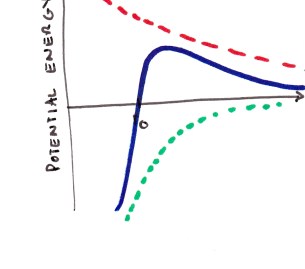
Push vs. Pull vs. distance
As we bring two atoms together from large distances, like one atom in NYC and the other atom in L.A, the interaction between the two atoms is negligible. As we bring them together, closer and closer, reducing the interatomic distance between them, two forces appear: an attractive force (trying to bring the atoms together) and a repulsive force (pushing the atoms apart). Why both? It makes sense that there is an attractive bonding force between the two atoms. What is slightly more surprising is that there is also a repulsive force. This happens because as you bring the two atoms closer together, the outer electron shells of each atom get closer and closer – and since the electrons have the same charge, they repel each other, just like bringing two magnets together. Both attractive and repulsive forces get really large when the atoms are brought even closer together, but ultimately the repulsive force wins, otherwise the atoms would just keep getting closer and closer until they collided and that would require huge amounts of energy. If you increase the distance again between the atoms, the attractive force eventually becomes larger in magnitude than the repulsive force. Which means that the atoms would be attracted to each other again! What’s going on here then? There is a certain distance, called the equilibrium spacing, where the force is zero. The attractive and repulsive forces balance out. And with zero force, the atoms are content to just sit there. Any attempt to push them together will decrease the interatomic spacing and the repulsive energy will start to go up – as soon as you release they will rebound to the equilibrium spacing. Try to pull them apart, and the net force becomes attractive – release them, and they will draw back together. This explains, then, why Young’s modulus is proportional to the slope of the force versus interatomic spacing at the equilibrium distance. Remember that slope is just rise over run, so the slope of the force versus interatomic spacing curve at the equilibrium point tells you how much incremental force is required for any incremental change in distance. Since Young’s modulus is the stress over strain, or how much incremental stress in the bonds will result in incremental changes in distance, you can see how closely related the two concepts are to each other.
An important note: some materials don’t actually have a linear elastic modulus. As soon as you start stressing the material, the strain increases non-linearly – it’s not a straight line up while in the elastic region, like it is for most (if not all) metals. Types of materials include gray cast iron, concrete, some polymers, and others.
Poisson’s Ratio
Relating how things stretch in different directions
If you take a rubber band and pull on it (creating a state of tension), you know that it will stretch. You also probably know that while it gets longer, it will also become thinner. That makes sense intuitively right? You can think of it like this: when you stretch it, you’re using some of the material to extend it, and so the band will shrink in other directions. This happens in metals too. If there is a strain in the x direction in the sample below, there will be strains in the z and y directions as well. If we know that the x-direction strain is say, 10%, can we know what the others will be? We can, and it is known as Poisson’s ratio, denoted by the letter ‘v’, which is defined as the ratio between lateral and axial strains. Typically, this number ranges from 0.25 to 0.35 for metals. If it is 0.25, then that means if the strain in the axial direction is 10%, the strain in the lateral directions will be 2.5%. The poisson ratio of rubber is about 0.5, meaning that the strain perpendicular to the direction of the applied force will be about half that of the strain in the direction of force. In other words, if you stretch an elastic to 100% of it’s original length, it will also be about half as thick as it originally was – it’s pretty easy to confirm this if you have an elastic band laying around, just by eyeballing it. Cork (like the cork on a wine bottle), on the other extreme, has a poisson ratio of closer to 0. If you compress it, it won’t become any thicker. If you stretch it, it won’t become any thicker.
Auxetics seem to defy logic
Some materials actually exhibit a negative Poisson’s ratio, which means that the strain perpendicular to the direction of loading will be the same sign as the strain along the direction of loading. Meaning if you had a rubber band with a negative Poisson’s ratio, and you stretched it, it would actually get thicker. These incredible materials are known as Auxetics. The reason this happens is because of a hinge-link structure, which flex outwards when stretched. The applications of this type of material could potentially be very useful. Imagine a bolt that when stretched actually gets thicker and wedges itself into the structure more. Uses of Auxetics include body armour and shock absorbing material. A material that you have probably handled today is Auxetic – paper. Paper will expand (although probably not enough for you to see) if you stretch it, due to its molecular structure. Some rocks are Auxetic, and so is Gore-Tex, if you have a coat with that in it.
Do we care about Poisson’s ratio?
Yes, although practically speaking, most materials that you work with or hear about will have a Poisson ratio of somewhere around 0.3 (i.e. metals). Here’s an interesting example of it really mattering: if you have a pipe system transporting water, and that water freezes, expands, and puts uniform pressure on the pipe, then the pipe will deform (hopefully elastically) outward – the diameter will increase. This also means, being a material with a positive Poisson ratio, the pipe will also get shorter. This could be an issue where the pipe connects to other pipes or joints – it could result in the failure of the pipe at these locations and end up in some costly repairs.
Yield Strength & Ultimate Strength
Why is Yield Strength an important material property?
Yield strength: arguably the single most useful material property to know (from a structural perspective) if one had to be picked. Explained simply: how strong is the material? If I have this specific part, and this loading, and we make it out of this material, will it fail or will it survive? The yield strength of the material will tell you. For instance: say you have a desk chair designed and sketched up on the computer. You’ll have a good idea of the load: to be conservative, you’d probably estimate the maximum mass of a person sitting on it to be around 300-400 pounds (you don’t want to be sued if the chair breaks). You might then multiple that number by some factor of safety, in case the person ends up being heavier, or maybe the chair isn’t designed exactly as you specified, or maybe your calculations are a bit off. If you pick a safety factor of two, then you will design the chair for someone that weighs between 600 and 800 pounds. From your chair’s geometry and the force of the person, you can determine the maximum stress that the design will experience. And now that you know the stress: what do we make this chair out of? Wood? Plastic, ceramic, steel? Aluminum or carbon fibre? The choice is yours, so long as the material is strong enough (and ignoring all other potential criteria, such as cost). The yield stress of the material should be greater than the maximum stress that the chair sees. If the maximum stress in the chair is 200 MPa, then you’d pick something maybe with a yield stress of 250 MPa. Meaning, 250 MPa is the stress at which the material will yield.
What, exactly, is yielding?
Yielding is when the strain in the material goes from being elastic (fully recoverable) to plastic (permanent). If you placed a large enough mass on the chair and the maximum stress in the material exceeded the yield strength of the material, then the material has yielded. The chair would be permanently bent, or stretched, or twisted or compressed. It would no longer be the same shape that it was originally – maybe obviously, maybe imperceptibly. Beyond this point, the yield point, Young’s modulus is no longer a thing. The stress is no longer linear with strain. The stress strain plot is no longer a straight line, but instead starts to curve. At this point, some of the atomic bonds that were previously just stretching are severed and reformed, but not with the same atoms. In many engineering applications, yielding is unacceptable. In most cases, the component needs to retain its original geometry in order to function as intended. Take a bike frame, for example. If it is bent and twisted, it may be more difficult to ride. A yielded chair might be slanted, or lower.
Yield is generally bad but not catastrophic
Engineers would like to stay away from yield for the reasons discussed above, but also stay away from yield because you are getting closer – perhaps dangerously close – to the ultimate strength of the material. At the ultimate strength, the material has been stressed as much as it can take, and will shortly begin to fracture and rip apart if the stresses grow any higher. At the ultimate strength of the material, the bike frame fractures, the chair leg bends and tears, the airplane wing snaps, the bridge supports collapse. It is much worse than yielding. From that perspective, yield is good. Yield gives us time to see that the part is damaged, but in many cases will continue to function – the failure has not been catastrophic. We can continue to use the damaged part if the function has not been too limited. We can continue to ride the bike even if the frame is a little bent.
How do we determine the yield strength of a material?
Sometimes it is difficult to determine exactly where the elastic region ends and the plastic region begins just by looking at the material stress-strain curve. It’s easy to see where yielding begins roughly, but pinpointing the exact stress is a bit up to interpretation. Is the yield stress right before the curve goes nonlinear? Right afterwards? To make it simple, there is a convention: you take a line parallel to Young’s modulus and offset it 0.002 along the strain axis (recall that strain has no units). Wherever this line meets the material stress strain curve, which is produced pulling on a specimen of material until it fails, is the yield stress of the material. Practically speaking, it is unlikely that you’d ever need to use this. Usually the material specifications are well know, and you will pick a material that meets your needs – you probably won’t be doing your own tests, but it’s good to be aware that this method can be used to estimate the yield stress using material data. Note that this method cannot be used for materials lacking a nonlinear elastic region, such as concrete, because there is no straight line to offset.
Simply put
The yield stress is really a measure of the ability of a material to resist plastic deformation. Aluminum strengths can be as low as 35 MPa – which is 5000 PSI or 5000 pounds per square inch in order to yield the material. While that may sound like a lot, consider that high strength steels can have yield strengths of 1500 MPa or higher (>200,000 psi).
Brittle & Ductile Materials
We can break up materials into two groups: brittle, and ductile. A brittle material is one that barely shows any plastic deformation, and just breaks, snaps, fractures instead. Like bending a piece of chalk. Chalk just fractures. Chalk is brittle. Glass does something similar. Many plastics are brittle. Some metals behave in the same way. If a material can’t experience strain beyond around 5% (i.e., stretch to at least 5% of it’s original length) then it is considered brittle. This is a material property known as ductility, which is the amount of plastic deformation before the material fractures and you can’t put it back together. Stretch a rod of steel in tension, say, and you can measure the length at which is fractures and it’s original length. If the original length is 100mm and it fractures at 125mm, then it has experienced 25% elongation – meaning that it is a ductile material.
You are here: Material Science/Chapter 1/Stress, Strain & Elasticity
<— Diffusion/Dislocation Movement —>
 the first year engineer