You are here: Circuits/Chapter 1/Current
Let’s begin with the basic building block of electricity: electrons.
1. Electrons
Electricity is a bit of a catch-all term for a number of different ideas and phenomena, so let’s stick to specifics to avoid confusion. Let’s talk about electric charge. Electric charge is usually in the form of electrons, which have a negative charge. Electrons, of course, are subatomic particles that move around the nucleus of an atom, which contains the protons and neutrons. Electrons have a negative charge, and protons a positive charge. Although the weight and size of protons and electrons differs drastically, the electric charge of each is actually equal. So keep in mind that electric charge can also refer to protons – although electricity is more commonly associated with electrons flowing. What’s important is that these electric charges can travel and create what we know as current, or the flow of electric charge. But they don’t just move freely through anything. You wouldn’t have much luck getting a charged to flow in a blade of grass. You need a conductor– a medium in which the electrons can travel. The conductor, typically metal and in the form of a wire (for most engineering purposes anyway) is made of atoms. How can that be useful to us then? Well, those same atoms have clouds of orbiting electrons. And metal is particularly useful because of the size of the atoms, which means the electrons tend to be further away from the nucleus and more loosely attached. In a block of metal, this ‘loose’ attraction results in a sea of electrons that don’t belong to any atom in particular. These electrons are the ones that are available to move when given the proper motivation.

2. Current
So the wire, being made of metal, contains a massive number of electrons, and some of them are loosely hanging around the nucleus of the atom – which makes them prime candidates for flowing. All that is left to do is get these electrons moving, and you have current – the flow of electric charge. So imagine the wire as a pipe filled with electrons, ready to go. How do we get these charged particles organized and ready to move in a generally the same direction? We need to give them some motivation, otherwise they will be perfectly content vibrating and whizzing around the nuclei of the atoms, but with no net change in direction. That motivation comes in the way of voltage; the drill sergeant, the motivator to get the electrons up and off their lazy asses. But first without discussing voltage, let’s add a battery to our wire and talk slightly more about those magical electrons. A battery is some sort of source of electrical energy right? One’s first intuition may be that a battery adds more electrons and there isn’t quite enough room for all of them and each loose electron without a good hold on the nucleus begins shoving on it’s neighbour with urgency for fear of being crushed by the massive number of electrons behind it, until a vast number of electrons are pushing along and current is created. That’s not true. In reality, the wire, before adding the battery, already contained all of the electrons necessary to create the current. Again, the battery does not add the electrons. It simply gets the electrons that are already contained in the wire moving; it acts as a pump. The analogy of the circulatory system in the human body works well – your heart isn’t making blood and distributing it through the circulatory system, but rather instead pumps preexisting blood throughout your body via arteries. Your heart stops (hopefully not anytime soon), and the blood remains, not flowing. Similar to a wire and a battery; remove the battery, and the electrons remain – they go back to swirling and dancing, without any real purpose or a care in the world.
The circulatory system analogy works well in some aspects for circuits. You can think of the heart, which provides the impetus for the blood to flow, but does not actually generate any blood itself as the battery. It provides the voltage. The blood represents the electrons, and is already contained in the veins and arteries. Similarly, the flow is directional. Oxygenated blood is pumped out of the heart through the arteries, and deoxygenated blood returns to the heart via veins – sort of like how electrons flow from one battery terminal to the other. The other main components in the system such as the kidneys and stomach can be thought of as electrical components.

What we’ve been talking about in the above paragraph is the flow of electric charge. The term for this is current. Avoid saying that the current is flowing – this really does not make much sense; it is equivalent to saying that the flow of charge is flowing. Either say ‘flow of electric charge’ or current – not a combination of the two. I make this mistake all the time, because it is just a common expression – but keep in mind that it is incorrect.
We now know the concept of electrical charge, and that some materials are good conductors, and some materials are good insulators. Metals, in general, are very good conductors due to their atomic structure and the number of free electrons – electrons that are loosely attached to the atoms. These electrons are constantly moving around in the metal, due to nothing more than the energy providing at room temperature. We can build a path for these electrons to flow and become useful by using a conductor such as a wire. Then we can have electrons flowing from some starting point to whatever destination that we require. The electrons will only flow on this wire – they will follow the path, as long as it is continuous. If there is a break in the wire, then electrons have nowhere to go. You can think of the break in the wire as air – which is what it is – and air is a poor conductor, so the electrons cannot flow across it to the start of the next wire.
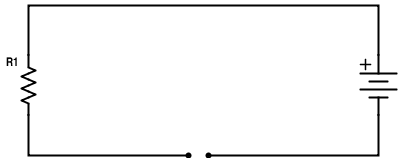
Another important concept is that the conductor must be a continuous loop. If it was just a single piece of wire, the electrons would still not have a place to go. They wouldn’t just flow to the end of the wire and then drop off into thin air. They need an unbroken path to continuously flow around. It seems a bit odd maybe at first, because these electrons don’t end up anywhere – they continue to follow the same path, over and over again. But, you’ll see the amazing things that we can do with this.
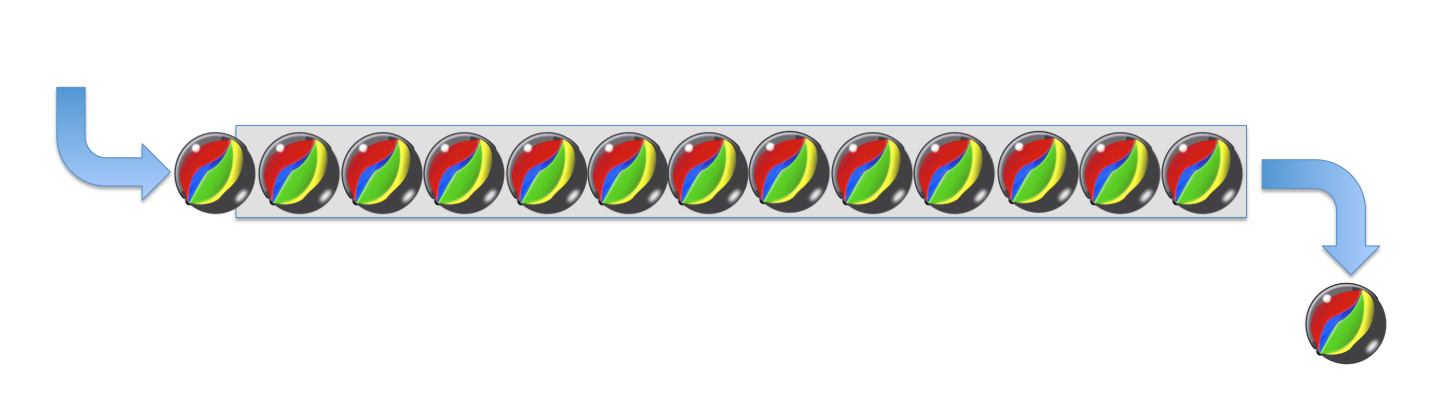
A popular analogy for electron flow is imagine a tube with marbles in it. The marbles represent the electrons, and the tube represents the conductor. You can see that the marbles have to flow within the boundaries of the tube – they are constrained, and cannot leave the tube, just as the electrons must remain within the conductor. The marbles in the tube must move as a group – one marble pushes on another marble, and in this way they flow. This is similar to how electrons flow.
Something that is a very interesting misconception is that the electrons are flowing at the speed of light. That is not true. Can you imagine if an electron flowing from a power plant 1000 km away reaches your outlet in 3 milliseconds? That would be catastrophic. Electrons have mass, and something with mass moving at the speed of light would have a very large energy indeed. It would come out of the outlet and blow you into oblivion. The truth is that the electrons flowing in a wire are actually moving on the order of millimeters per second. So very slowly – much slower than walking pace. This is referred to the drift velocity of the electron.
This misconception probably came about because electrons in the conductor all move instantaneously. If an electron begins flowing at the beginning of the circuit, an electron at the end of the circuit will virtually begin moving at the same time. This speed at which the electrons affect each other is equivalent to the speed of light – nearly 200,000 miles per second.
Let’s do a thought experiment. Say we bought marbles and filled a narrow pipe from NYC to LA, a distance of 4,497km. The tube is just wide enough for one marble. All the marbles are continuous in the pipe (so we’d need just under 225 million marbles, assuming a diameter of about 2cm). So we push on the first marble in NYC, and nearly instantaneously the last marble in LA begins moving. This is because all the marbles are touching and the force is transferred quickly between all of them, even though each marble is moving quite slowly. We can ignore negligible affects and call this the speed of light, for arguments sake. Now replace the marbles with electrons and the tube with a conductor. We can see that the electrons move very slowly indeed, but the signal is moving at or near the speed of light.
You are here: Circuits/Chapter 1/Current
Back to Start: Chapter 1: The Basics
Next Topic: Voltage
 the first year engineer