1. The Direction of Current Flow
We’ve discussed electrons and how they can move in a conductor. We also know that voltage provides the motivation for these electrons to move. But what direction do these electrons move? This is quite important for the design of circuits! A history lesson is necessary here.
2. Historical Context
Benjamin Franklin, born in 1706, one the Founding Fathers of the United States, the guy on the american $100 bill, an author, printer, political theorist, politician, postmaster, scientist, inventor, activist, statesmen, and diplomat, the guy that flew the kite in the storm to prove that lightning is electricity – really messed things up for us. Here’s the issue. We now know that electrons (negatively charged) are responsible for current. Ben Franklin believed that the reverse was true – that the flow of electricity was due to the flow of positive charges. He’s not wrong in all cases; the majority of the time it is the negative electrons that do the flowing, but occasionally you will come across a type of circuit or some application where positively charged particles are flowing as well. So, since he believed that the positive charges were flowing, the convention became that the direction of current is the direction that positive charges are moving. This convention is still used today.
So an example here. We know that batteries have two terminals, a positive and negative terminal. With Benjamin Franklin’s convention, the direction of current is from the positive terminal to the negative terminal, since this is the direction that a positive charge would flow. It would originate at the positive terminal, be attracted to the negative terminal, and away it goes. The issue is that, of course, the opposite happens. Electrons are doing the flowing, and they are attracted to the positive side. So while the convention states that current flows from the positive to the negative terminals of a battery, the opposite is actually true. How big of an issue is this, actually? Not much. Although it may seem odd at first, and definitely very outdated, everyone has become accustomed to it and it doesn’t really mess things up all that much, so we can forgive Benjamin Franklin for that one mistake.
3. Electron Drift and Amperes
We already discussed that the current moves at the speed of light, but that the electrons flowing in the conductor are moving very slowly indeed. The fact that current moves so quickly, as discussed with the marbles analogy, means that when you flick a light switch, all the electrons in the circuit begin moving all at once, and the light comes on instantly. There is a term for the actual speed of the flowing electrons: drift speed. Drift speed refers to the average distance that the electrons move during a period of time. Essentially, the speed of the electrons. Interesting to note that the electrons don’t exactly move in a straight line in the wire, they zig-zag around a little bit as they move through all of the fixed atoms. You can think of the electrons as colliding with the fixed atoms, and the collisions change their course, and at times they may move backwards before moving forward again. It’s sort of like one step back, two steps forward, and the result is that the electrons move steadily forward with the progress occasionally disturbed by these collisions. How fast are we talking here? Earlier, I stated that they move millimeters per second. An easier visualization is that they move about 1 meter, or 3 feet, every hour. So a power plant may generate power from 1000 km away and it would reach your outlet nearly instantaneously (simplifying it a bit here), the actual electron would take 1 million hours to move that distance.
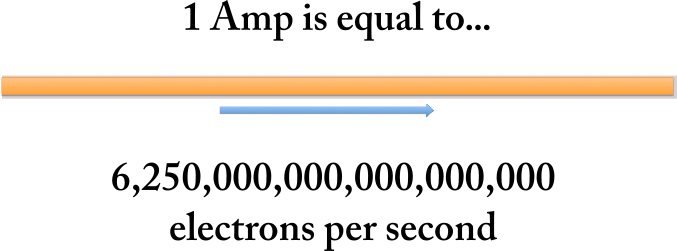
The unit of current is amperes, or amp for short (A). One amp is equal to one coulomb per second. We know what a second is. But what is a coulomb? I coulomb is one unit of charge. Now, the charge of an electron is very, very small. It is only 0.00000000000000000016 coulombs. To get one whole coulomb, we need 6,250,000,000,000,000,000 electrons to get an entire coulomb. So if one amp is one coulomb every second, then one amp is 6,250,000,000,000,000,000 electrons every second. That’s a rather large number, and you probably can’t visualize it. The number of cells in the entire human body is estimated at 1,000,000,000,000,000. So the number of electrons flowing in one amp means that about 6300 times more electrons are moving in that conductor than you have cells in your entire body. And that’s happening at any point in the circuit every second. Take a cross-section of the conductor at any point, and that’s how many electrons you would see passing through every second. That is truly mind-boggling. We can see that although the electrons are moving slowly, there is such a vast number of them that it doesn’t really matter. It’s like a huge traffic jam. Think of a highway with trillions of lanes, and it’s gridlock. Paint a line across the highway, and although the cars are moving slowly, you’re still going to have trillions and trillions of cars moving across that line.
4. AC/DC

This is probably a good place to have a discussion about the two different types of current. Turns out it’s extremely useful to have two different types. Those flowing electrons, which we’ve come to know so well, can either flow in the same direction constantly, which is known as direct current (DC), or they can keep changing their mind and flow a little forward, stop, and flow a little backwards, which is alternating current (AC). Electrons in alternating current never actually get anywhere: their net travel distance is zero. It would be like walking back and forth along a city block for your entire life. You’d have walked a great distance, but you wouldn’t have gone anywhere at all. The electrons in direct current do get somewhere, since they travel in the same direction constantly (although very slowly).
What does this mean for energy? Energy always moves “forward” regardless of the current direction. So with alternating current, the circuit is transferring energy to say, the lightbulb, as long as the current is flowing: the direction doesn’t make a difference. Those electrons are constantly being squeezed through the filament and creating light, regardless of the direction they are traveling in. What does the position of current look like over time? Usually it resembles a sinusoidal wave. The current will begin at 0 amps, rise to a peak, and then decrease (passing through zero again) and peak at some negative amps (negative in this case just means the opposite direction). It is also possible to have triangular wave patterns or square, for different applications. How frequently does it changed direction? The standard frequency of electricity in North America is 60Hz, which means that it changes direction 60 times in one second – essentially vibrating back and forth. 1 Hz is simply once per second.
So why are there two different currents? In some cases, AC is better and more efficient than DC, especially in the case of generators. To discuss the exact details, you’ll need to have a better understanding of Faraday’s Law of electromagnetic induction. This is getting more into higher power applications and a bit more relevent for the design of power grids, so we’ll end the discussion here (but there is plenty that you can read about it further if you are interested). Essentially, it is easier to change the voltage of the AC current than it is for DC current and better for mass power distribution (i.e. transmitting power from a power plant to your house).
Previous Topic: Voltage
Next Topic: Wax and Wool
 the first year engineer